
Why composting matters
Reducing Methane Emissions
When food scraps end up in a landfill, they decompose without oxygen and release methane—a greenhouse gas more potent than carbon dioxide. Composting offers a better path. By diverting food waste to a composting facility, we turn those scraps into something useful instead of letting them contribute to climate change. In December 2025, Colorado adopted Regulation 31, a new air quality standard targeting methane emissions from landfills. This makes it more important than ever to keep food waste out of the landfill and into composting programs like ours.
Building Drought Resilience
Colorado is no stranger to drought, and Montezuma County feels it like the rest of the state. One of the best things we can do for our soil is add compost. Compost improves soil structure and increases its ability to absorb and retain water, which means less runoff and more moisture staying where plants need it. Healthy soil can hold up to 20 times its weight in water, reducing the need for frequent irrigation. For local farmers and gardeners, that translates to lower water bills and more resilient crops during dry spells. By turning food scraps into compost, we're creating a resource that helps our community adapt to Colorado's changing climate.
Improving Soil Health
Healthy soil is the foundation of a healthy garden or farm. Compost adds essential nutrients like nitrogen, phosphorus, and potassium back into the ground, reducing the need for chemical fertilizers. It also introduces beneficial microorganisms that help plants absorb nutrients more effectively and fight off disease. Over time, compost builds up organic matter in the soil, improving its structure and making it easier for roots to grow deep and strong. By turning food scraps into compost, we're giving our local growers a natural, affordable way to keep their soil in good shape for years to come.
Montezuma County is investing in composting.
Montezuma County has been building something special at our local landfill: a 5.5-acre commercial composting facility that has the potential turn our food scraps into compost.
The Montezuma County Landfill has invested hundreds of thousands of dollars into its composting infrastructure in the past few years. In 2020, the facility acquired a new trommel screener with help from a $127,500 grant from the Colorado Department of Public Health and Environment. In 2022, the operation expanded further with the purchase of a Backhus A58 Windrow Turner, funded largely by a $379,000 state grant. Together, this equipment handles the turning and mixing of compost piles and the screening of finished compost into a high-quality soil product.
However, not all compost is the same. Right now, the landfill solely produces compost from biosolids, which is produced from treated sewage sludge at the Cortez Water & Sanitation District. (They offer tours if you want to geek out on the sludge!) This type of compost is great for flower gardens, lawns, and trees, but is not recommended for vegetable gardens.
The compost made from MoCo Compo’s collections, on the other hand, comes entirely from food scraps and other organic material: vegetable peels, coffee grounds, eggshells, yard trimmings, and the like. Unlike biosolids compost, food waste compost is safe for use in vegetable gardens, making it more versatile for local growers.
Since the start of 2026, MoCo Compo and the Landfill have been working together to design a separate space at the composting facility for your buckets to fill, allowing us the opportunity to begin producing a second, higher-grade of compost right here in Montezuma County. Wooh!
Our Service Territory
We currently service the City of Cortez, Town of Mancos, Town of Dolores, and Town of Rico. As a small business just getting started, we're focusing on these concentrated areas first to make sure we can serve our customers well.
We're working to expand across all of Montezuma County. If you try to sign up from outside our current service area, our system lets us know—and we use that information to plan where we grow next. So even if we can't reach you yet, signing up helps us get there sooner.
Who We Are
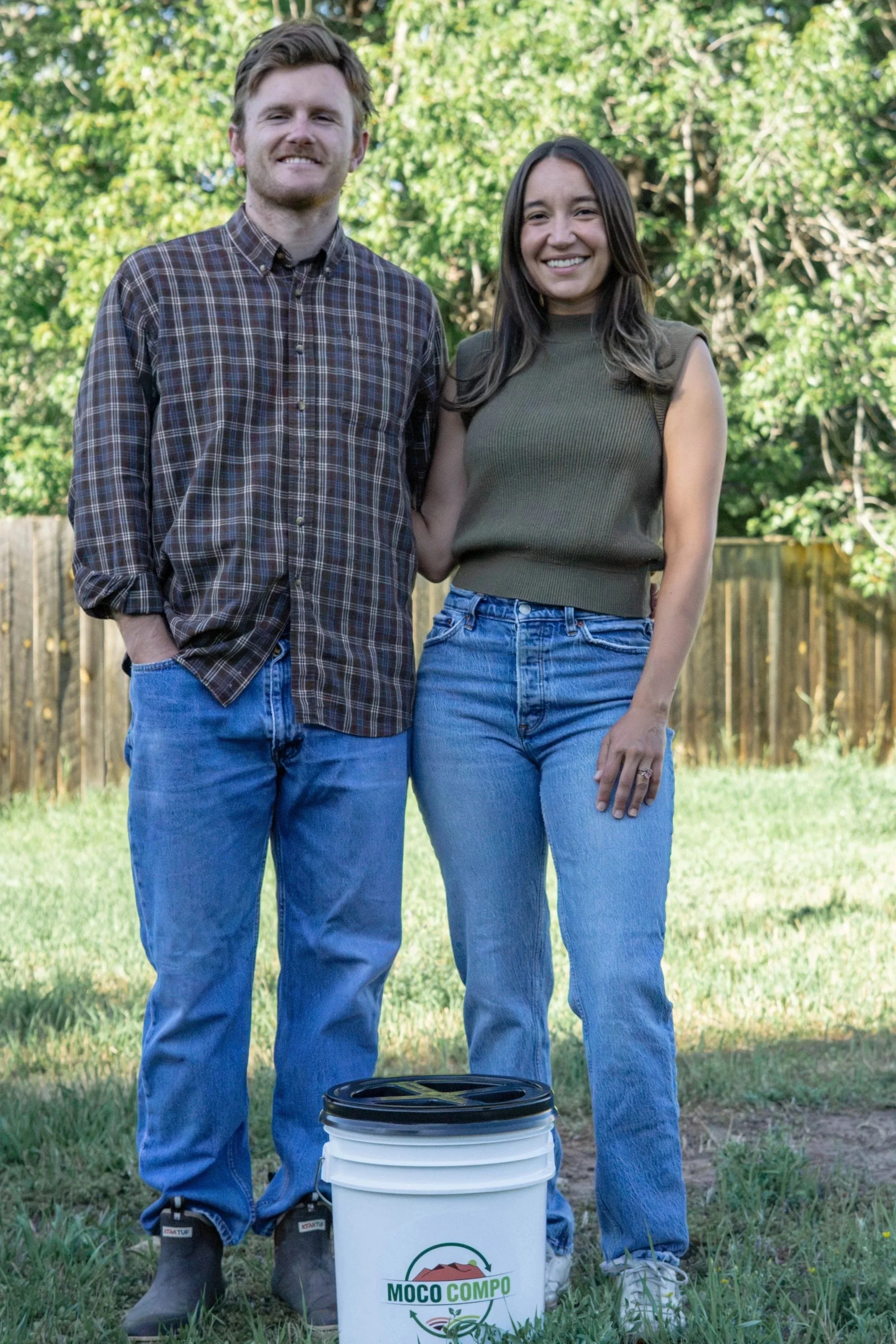
We're Erin and Oliver, and we live right here in Dolores. Between the two of us, we have over a decade of experience in policy, energy, water, and law. We spend a lot of time thinking about how systems work and how they can work better.
We also have a garden. And like a lot of home gardeners, we found ourselves with more food scraps than our backyard compost pile could handle. We didn't want those scraps ending up in the landfill, where they would decompose and release methane into the atmosphere. So we started thinking about what else we could do with them.
That's when we learned about the composting facility at the Montezuma County Landfill and realized there was a gap in the system: the county has the equipment to compost food waste, but no way to collect it from residents. A classic last mile problem.
So we started MoCo Compo to solve it. Our goal is simple: keep food scraps out of the landfill and turn them into something useful for our community.
Contact us
Have questions about our curbside composting service? Fill out the form and we’ll be in touch shortly!